Market research in minutes, not weeks.
Size up competitors, check pricing or spot trends in any market. Agents verify every claim and cite the source.
How a question becomes a report you can trust
Five agents split the work. If the evidence is thin, they go back for more before a word is written.
Plan
planner
Works out which companies, sources and official pages to check.
Research
researcher
Searches the live web and reads the best pages in full.
Verify
evidence analyst
Pulls out every claim with its source and flags where sources disagree.
Decide
decision engine
Scores each finding: is it real, what kind, how big. Weak evidence means another round.
Write
synthesizer
Writes your report. Anything unverified is labelled, never stated as fact.
One question, eight kinds of report
Research your own product's market, a competitor, or a whole category. Pick the report before you run.
- BRIEF
What changed in your market and what to do about it, ranked by impact.
> What changed in the plant-based food market this year?
- PROFILE
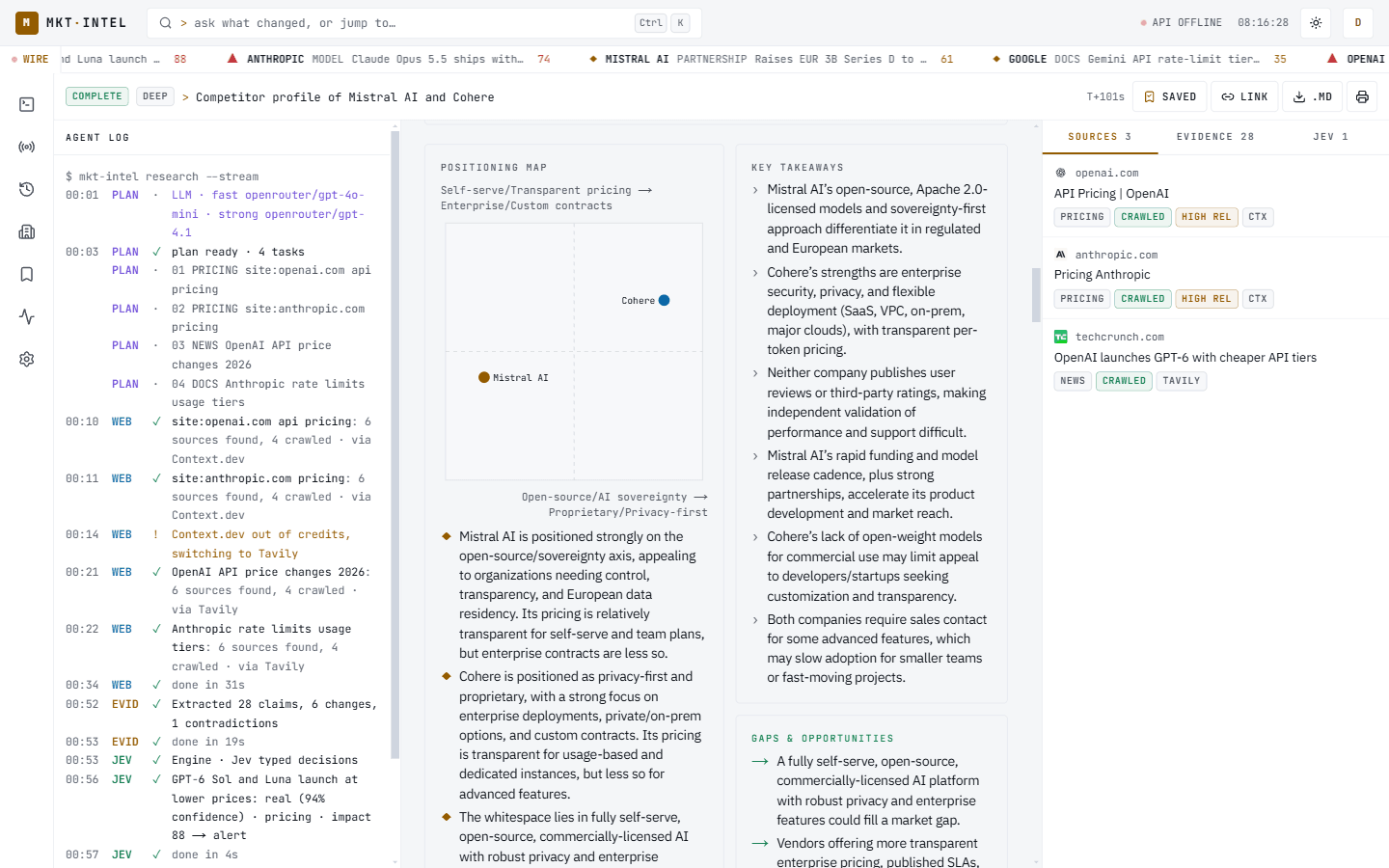
Side-by-side profiles of each competitor: positioning, pricing, customers, strengths and weaknesses, plus a positioning map.
> Competitor profile of Notion, Coda and Confluence
- PRICING
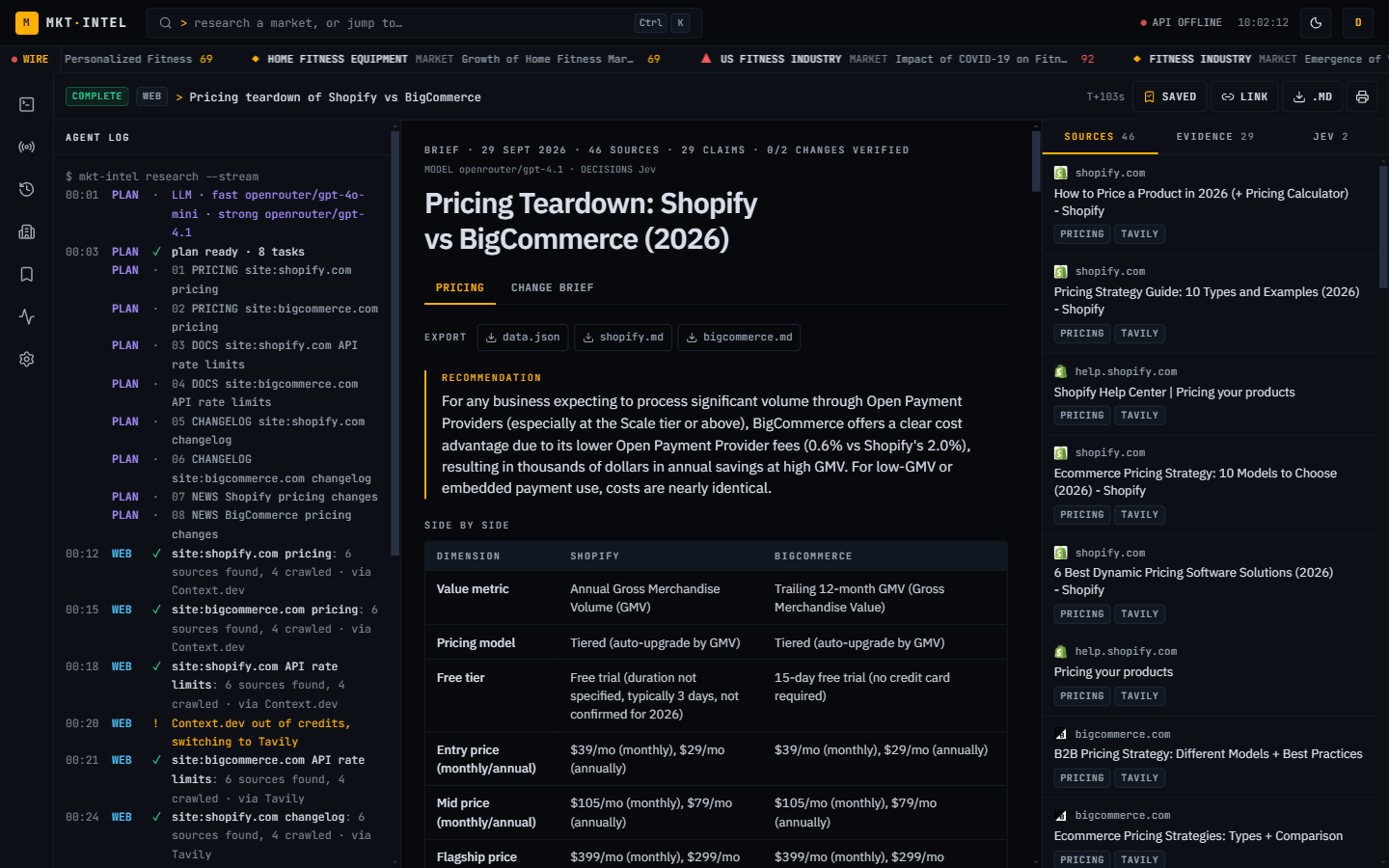
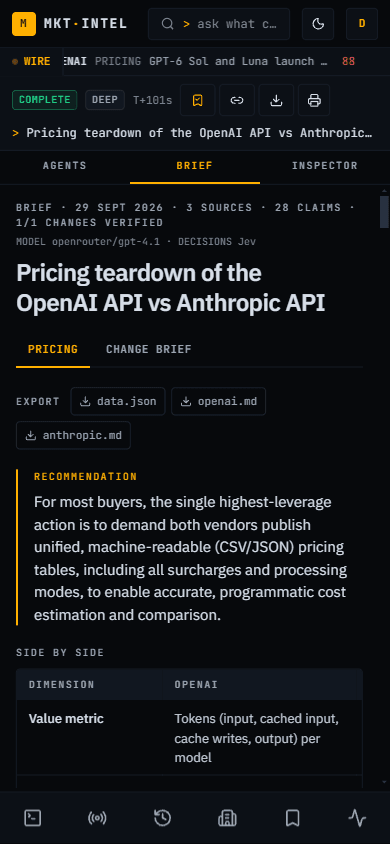
Every tier and hidden cost, what a typical customer pays on each, and how clear each pricing page is.
> Pricing teardown of Shopify vs BigCommerce
- BATTLECARD
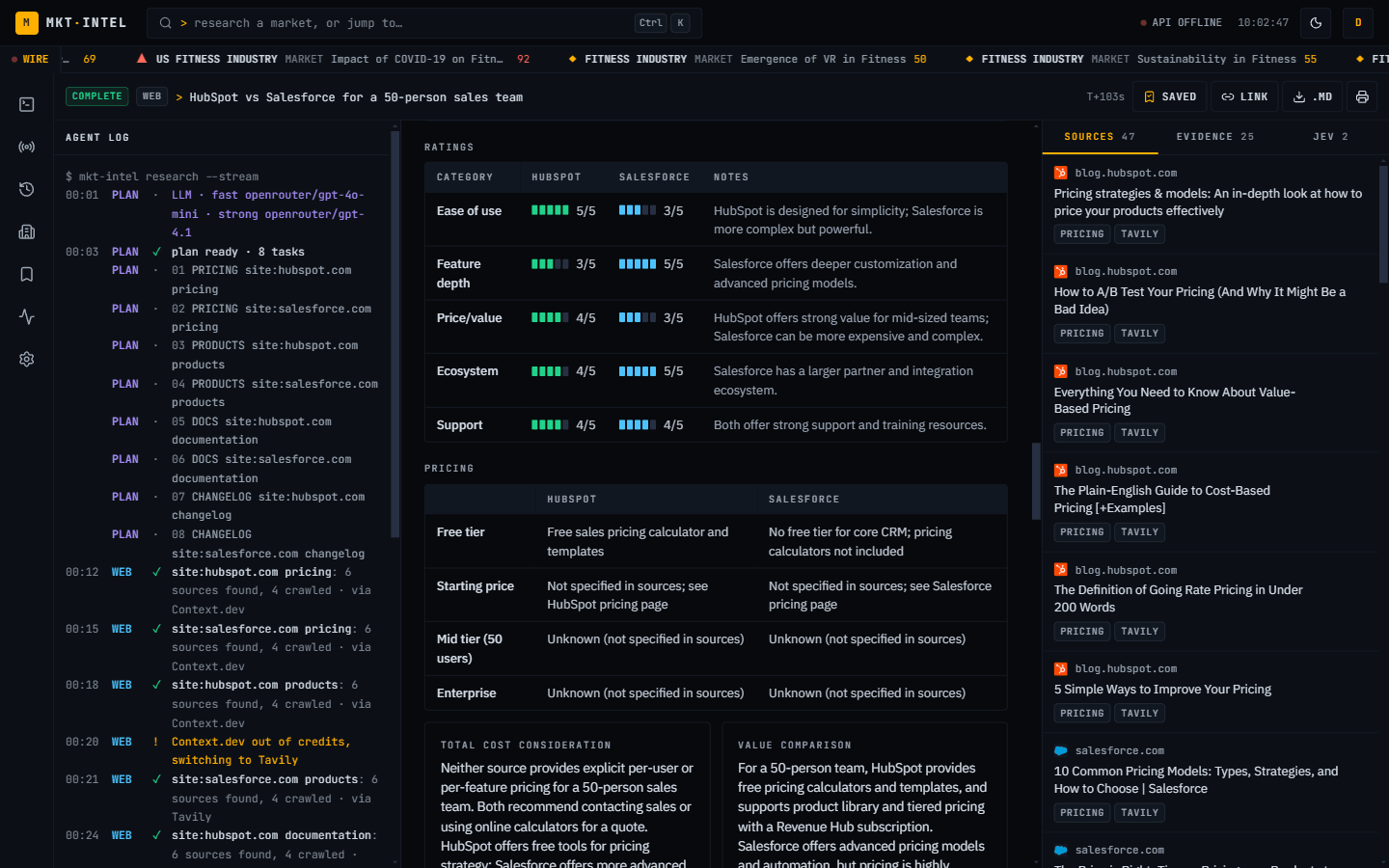
Where each side wins, answers to common objections, questions that expose weak spots, and who should pick which.
> HubSpot vs Salesforce for a 50-person sales team
- LANDSCAPE
A market map of every player by category and stage, a capability matrix, SWOT for a new entrant, and the trends moving the market.
> Project management software market
- PAIN
What customers complain about, ranked by share of mentions, with real quotes from reviews and forums and the gaps nobody fills.
> What do users complain about in Notion?
- SIZING
TAM, SAM and SOM built from sourced inputs you can check, with growth history, forecasts and bear, base and bull cases.
> Size the US home fitness equipment market
- OPPORTUNITY
Where demand is high and competition is thin, the risks to plan for, and a clear go or no-go with first steps.
> Should I build a budgeting app for freelancers in India?
The research, the report and every source on one screen
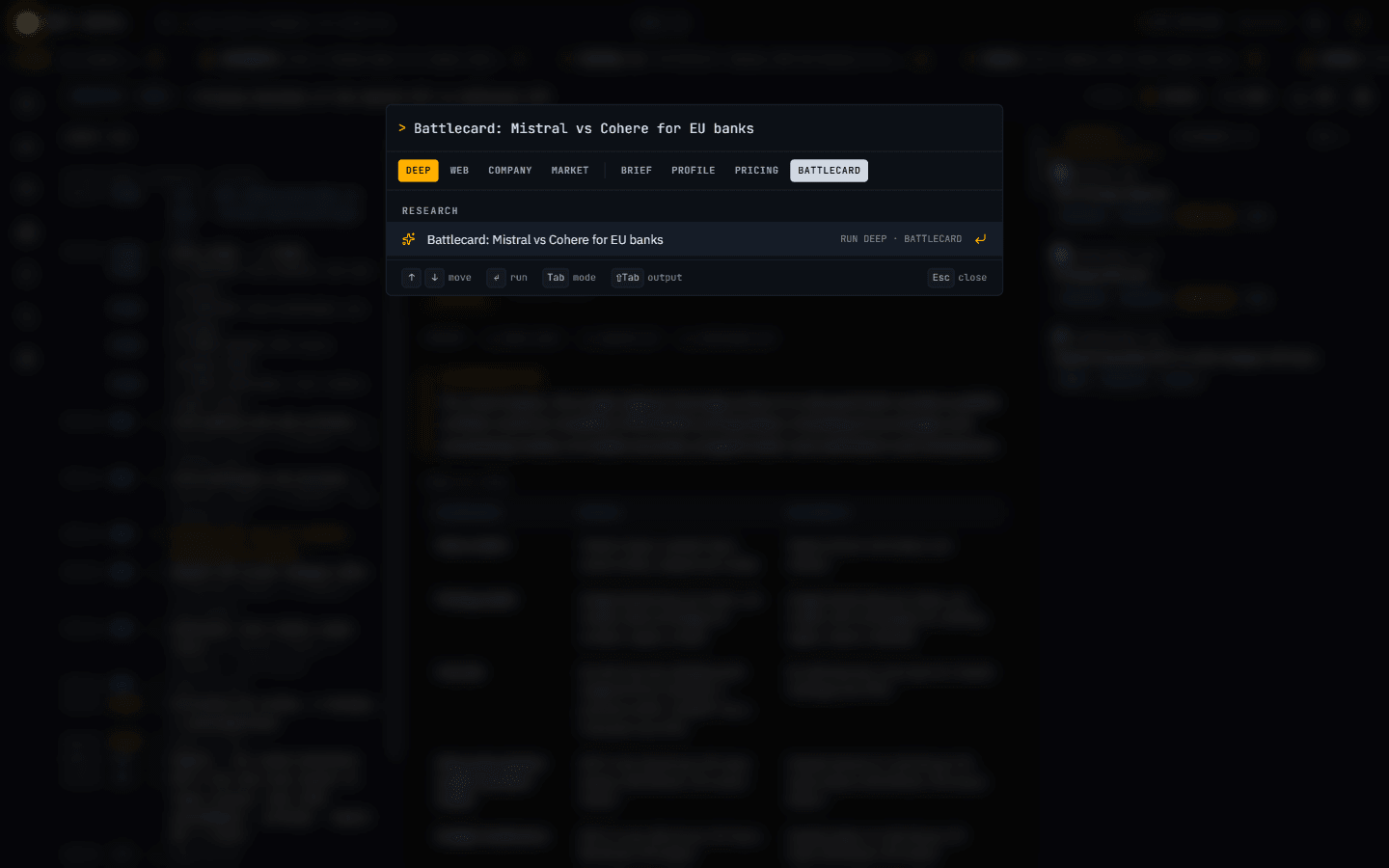
Built so you can check every claim
Example: a competitor raises its entry price
- real change
- 92%
- type
- pricing 72%
- impact
- 87 / 100
- action
- alert
Research you can trust
- A next step for every finding
- Each finding gets a probability that it is real and an impact score, then a clear call: alert, investigate, monitor or ignore.
- Runs finish when a provider runs dry
- Three search providers with automatic fallback, so one running out of credits never stops a report.
- See how the report was built
- Watch every search, page and decision as it happens in the live agent log.
Your keys, your models
- Bring your own keys
- Use your own OpenAI, Anthropic, Gemini or OpenRouter key. Pick a fast model for the legwork and a strong one for the writing.
- Jev is optional
- No OpenRouter key? A built-in decision agent gives the same scores with the key you already have.
Fits your workflow
- Signals and watchlist
- Verified findings from every run in one feed. Companies join your watchlist as they come up.
- Download anywhere
- Every report downloads as a designed PDF, an editable PowerPoint deck with native charts, or an Excel workbook. Markdown and JSON too.
- Keyboard first
- Ctrl K to start anything, number keys to switch views, j and k to move through lists.
How the system fits together
Browser
Next.js 16 UI
SSR pages on Vercel
live SSE stream
FastAPI on Render
LangGraph agent
key gateway (BYOK)
run registry and meters
LLM
OpenAI, Anthropic, Gemini, OpenRouter
Decisions
Jev via OpenRouter, or LLM agent
Web data
Context.dev → Tavily → Firecrawl
InsForge
auth and Postgres with RLS
- Frontend
- Next.js 16 App Router, React 19, Tailwind CSS v4, on Vercel
- API
- FastAPI with server-sent events, Docker on Render
- Orchestration
- LangGraph state graph with LangChain structured output
- Reasoning
- LLM gateway: OpenAI by default, or your own Anthropic, Gemini or OpenRouter key
- Decisions
- Jev typed decisions via OpenRouter, or an LLM decision agent with the same outputs
- Web data
- Context.dev, Tavily and Firecrawl
- Auth and data
- InsForge: email and OAuth sign-in, Postgres with row-level security
The full architecture, data model and decision rules are in the architecture guide.
Frequently asked questions
- What is MKT·INTEL?
- An AI market research agent. Ask about your market, a competitor or a trend, and agents research the live web, verify each claim and write a sourced report with recommended actions.
- Which markets does it cover?
- Any market with a public web presence: software, consumer brands, retail, fintech, health and more. It works best where companies publish pricing, product pages and news.
- How is it different from a chatbot with web search?
- Every finding is checked by a typed decision engine (Jev) that scores whether it is real, what kind of change it is, how big the impact is and how strong the evidence is. Weak evidence triggers more research instead of a confident guess.
- Which sources does it use?
- Live web search and full-page reads through Context.dev, Tavily and Firecrawl. It starts with official pricing pages, product pages, docs and blogs, then review sites, industry reports and credible news. Social media reposts are filtered out.
- How long does a report take?
- About a minute for a quick brief, and two to three minutes for a full competitor profile, pricing teardown or battlecard.
- Is it free?
- Yes. Create an account and run reports on the platform keys, or add your own keys to choose the models.
- Can I use my own API keys and models?
- Yes. Add an OpenAI, Anthropic, Gemini or OpenRouter key and pick a fast model for planning and a strong model for the report. Keys are encrypted at rest and never sent to the browser.
- Do I need a Jev subscription?
- No. With an OpenRouter key you get Jev. Without one, decisions run on a built-in decision agent using your own key, with the same checks and output.
- Is it open source?
- Yes. The code is on GitHub, including the LangGraph agent, the FastAPI backend and this Next.js frontend.
Find out what changed. Decide what to do.
Create a free account and have your first report in minutes.